Tuesday, April 28, 2009

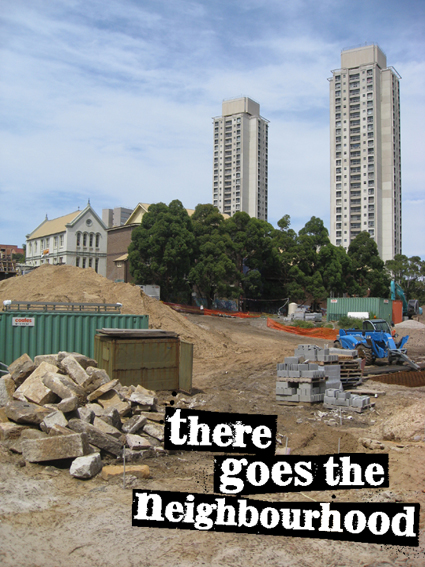
There Goes The Neighbourhood


There Goes the Neighbourhood is an exhibition, residency, discussion and publishing project for May 2009. The central element of this project will be an exploration of the politics of urban space, with a focus on Redfern, Sydney. The project will examine the complex life of cities and how the phenomenon of gentrification is altering the relationship between democracy and demography around the world. While urban change itself is not always a bad thing, gentrification often happens at an accelerated rate, out pricing the lower income and marginalized communities from the neighbourhood and dislocating them from their existing connections to urban space. The project brings together artists from Australia and around the world whose work addresses these issues.


White man got no dreaming, Michael Rakowitz (2008)

The Politics of Urban Space...

What exactly is the mode of existence of social relationships?... The study of space offers an answer according to which the social relations of production have a social existence to the extent that they have a spatial existence; they project themselves into a space, becoming inscribed there, and in the process producing that space itself
– Henri Lefebvre.


There Goes the Neighbourhood is the ironic chorus to the 1992 Body Count song which lamented the invasion of the once poor (and Black) into the neighbourhood of the rich (and white). But an alternative destruction of “The Neighbourhood” can happen when the poor get pushed out of their local community as part of the process of gentrification. This issue is particularly relevant for the suburb of Redfern, an inner city suburb of Sydney which has been home for a large working class and Indigenous community, and which is undergoing a process of rapid development and change.

The Block, Redfern, has been described as the "Black Heart" of Australia and occupies a unique place within Sydney's urban landscape as a centre for the Indigenous community. It was the site for the Aboriginal Tent Embassy, and has been the gathering point for many protests and community events. Just minutes from the second busiest train station in Sydney are the open camp fires and communal use of public space of the community on The Block. The Aboriginal Housing Company has had a long standing dream, just recently given the green light by the government to build The Pemulwuy Project; a new community housing project and cultural centre for Redfern's Aboriginal community. Redfern is also home to a number other non-Indigenous community housing projects such as the Department of Housing buildings (known as the "Suicide Towers") which the government is trying to redevelop. The suburb was once a strong working class neighbourhood and was the starting point for the 1917 general strike for a shorter working week: but in the 1980s the rail yards were closed down and transformed into a new cultural centre (where one of the exhibition venues Performance Space is based). Redfern grabbed headlines in 2004 when riots erupted when the police killed a 17 year old Aboriginal boy after chasing him in police cars as he rode his push-bike home. In that same year the Redfern-Waterloo Authority was established - a special government committee to oversee the rapid development and gentrification of the area. Redfern thus involves a complex, contested and controversial overlapping of uses of urban space.

There Goes the Neighbourhood is an exhibition, residency, discussion and publishing project for May 2009. The central element of this project will be an exploration of the politics of urban space. It will explore the complex life of cities and how the phenomenon of gentrification is altering the relationship between democracy and demography around the world. While urban change itself is not always a bad thing, gentrification often happens at an accelerated rate, out pricing the lower income and marginalized communities from the neighbourhood and dislocating them from their existing connections to urban space.

As Henri Lefebvre reminds us “the social relations of production have a social existence to the extent that they have a spatial existence; they project themselves into a space, becoming inscribed there, and in the process producing that space itself”. The tussle over space is always one over the social relationships which are generated within the logic of place: revolving around people occupying, owning, seizing, developing, losing or transforming this space.

The project will bring together a smallish group of artists who have worked in various artistic projects which have explored the relationship between community and space and invite them to develop these issues further in the contested local environment of Redfern.


There Goes The Neighbourhood: Redfern and the Politics of Urban Space

To download a PDF of the book click here

There Goes the Neighborhood begins with a close study of Redfern before expanding into international examples to provide a detailed exploration of how the phenomenon of gentrification is altering the relationship between democracy and demography around the world. This book has been published in tandem with an exhibition of the same name and many of the contributions come from participating artists in the exhibition: Brenda L. Croft (Australia), 16beaver (USA), Daniel Boyd (Australia), Temporary Services (USA), Jakob Jakobsen (Denmark), Lisa Kelly (Australia), SquatSpace (Australia), Claire Healy and Sean Cordeiro (Germany/Australia), Evil Brothers (Australia), You Are Here (Australia), Michael Rakowitz (USA), Miklos Erhardt and Little Warsaw (Hungary), Bijari (Brazil) and Democracia (Spain). The book also includes contributions from key thinkers about the complex life of cities such as the Situationists, Mike Davis, Brian Holmes, Gary Foley and Elizabeth Farrelly.

There Goes The Neighbourhood is edited by Keg de Souza and Zanny Begg from You Are Here, a Sydney based art collective which focuses on social and spatial mapping.

Thursday, April 23, 2009

Discover Kauai


Surfers vs. the Superferry / Jerry Mander & Koohan Paik / The Nation

We don't ordinarily seek inspirational models of grassroots uprisings--especially against global corporate-military boondoggles--from surfer beaches on luscious tropical islands. So it surprises colleagues on the left when we tell them they might check out some surprising events on the small "outer" islands in Hawaii that may have an impact on grand US aspirations for military domination of the Pacific basin. Few mainlanders have heard about it, but Hawaii is up in arms.

It all started in 2001 as a purportedly modest "local" effort to offer inter-island ferry service to "help local people more easily visit their relatives on other islands, and carry their farm produce to market." Most locals liked the idea but soon found that this ferry, the gigantic Hawaii Superferry, was an environmental nightmare. It uses far more fuel (in total and per person) than big planes. It races at high speed (40-45 miles per hour) through zones teeming with endangered humpback whales, dolphins and rare sea turtles. It could transport dangerous invasive species to pristine islands. And it carries hundreds of cars to tiny places already choking on traffic.

...CONTINUE READING...


Coup de Superferry
/ The Hawaii Independent


A Boatload of Trouble / Against the Grain


The Superferry is not some benign way of connecting the Hawaiian islands. According to Koohan Paik and Jerry Mander, the massive boat is closely connected to US military plans for a new Pacific fleet. It also endangers whales and other wildlife. Paik was part of momentous protests in Kauai that rebuffed the Superferry.

The Superferry Chronicles: Hawaii’s Uprising Against Militarism, Commercialism, and the Desecration of the Earth / Jerry Mander & Koohan Paik

Hawai'i Superferry News at DMZ Hawai'i / Aloha 'Aina

An Interview with Koohan Paik and Jerry Mander / Akaku: Maui Community Television


The SuperFerry Chronicles I of V


A Video Challenge to Green Shoppers / Dot Earth

The New Geography

The New Geography: A Roundtable

By Jeffrey Kastner, Tom McCarthy, Nato Thompson, and Eyal Weizman

bookforum.com / Apr-May 2009

The present epoch will perhaps be above all the epoch of space. We are in the epoch of simultaneity: we are in the epoch of juxtaposition, the epoch of the near and far, of the side-by-side, of the dispersed. We are at a moment, I believe, when our experience of the world is less that of a long life developing through time than that of a network that connects points and intersects with its own skein.

—Michel Foucault, “Of Other Spaces,” 1967


The practice of geography is by its nature a ticklish, paradoxical enterprise. It is at once the study of objects and of subjects, of things and of behaviors, of the world around us as a phenomenon producing human activity and produced by it. A realization of the generative potential in such dichotomies—between the material and the symbolic, between places as conceived and places as experienced, between spatial and temporal models of existential understanding—has long influenced the academic discipline of geography. And in today’s world, where the familiar order of things seems increasingly contingent and fluid, destabilized by political and military turmoil, economic upheaval, and rapid technological development, a similar impulse among artists, writers, architects, and other cultural producers to interrogate and reimagine conventional notions of the physical and social landscape we inhabit grows only more vivid.

Each of the participants in this roundtable has developed innovative and unique practices that engage questions of space. Tom McCarthy’s role, since 2000, as a conceptual provocateur in the “semi-fictitious avant-garde network” known as the International Necronautical Society (INS) finds literary expression in his first novel, Remainder (2007), in which an unnamed protagonist, almost killed by a piece of high-tech debris that falls from the sky, awakens from a coma with his worldview permanently altered. Obsessed with finding a sense of heightened authenticity in the world around him, he’s driven to replay, to literally reenact, certain resonant moments that challenge his (and the reader’s) notions of space and time, as well as the kinds of activities—mundane and exceptional—that necessarily take place in both constructs. Nato Thompson’s work as a curator and writer has consistently examined the potential of social space as an arena for the artistic production of meaning. He persistently probes the idea, as he’s written, that, “ultimately, all phenomena resolve themselves in space. Cultural and material production are not simply abstract ideas, but are forces that shape who and what we are, and they do so in places we can walk to, intervene in, and tour.” Architect and theorist Eyal Weizman, meanwhile, has long focused his scholarship on the relationship between architecture and planning and the intractable social, political, and military conflicts between Palestinians and Israelis. Weizman is the author of Hollow Land (2007), which, he writes, “looks at the ways in which the different forms of Israeli rule inscribed themselves in space, analyzing the geographical, territorial, urban and architectural conceptions and the interrelated practices that form and sustain them.”

The four of us, two in London and two in New York, held a conversation within the spatially indeterminate surroundings of the Internet over the course of a week early last February from which the following transcript is taken.

—Jeffrey Kastner

...CONTINUE READING...

Sunday, March 08, 2009

Experimental Geography: From Cultural Production to the Production of Space


Experimental Geography: From Cultural Production to the Production of Space / Trevor Paglen / The Brooklyn Rail

When most people think about geography, they think about maps. Lots of maps. Maps with state capitals and national territories, maps showing mountains and rivers, forests and lakes, or maps showing population distributions and migration patterns. And indeed, that isn’t a wholly inaccurate idea of what the field is all about. It is true that modern geography and mapmaking were once inseparable.

Renaissance geographers like Henricus Martellus Germanus and Pedro Reinel, having rediscovered Greek texts on geography (most importantly Ptolemy’s Geography), put the ancient knowledge to work in the service of the Spanish and Portuguese empires. Martellus’s maps from the late 15th Century updated the old Greek cartographic projections to include Marco Polo’s explorations of the East as well as Portuguese forays along the African coast. Reinel’s portolan maps are some of the oldest modern nautical charts. Cartography, it turned out, was an indispensable tool for imperial expansion: if new territories were to be controlled, they had to be mapped. Within a few decades, royal cartographers filled in blank spots on old maps. In 1500, Juan de la Cosa, who accompanied Columbus on three voyages as captain of the Santa Maria, produced the Mappa Mundi, the first known map to depict the New World. Geography was such an important instrument of Portuguese and Spanish colonialism that early modern maps were some of these empires’ greatest secrets. Anyone caught leaking a map to a foreign power could be punished by death.

In our own time, another cartographic renaissance is taking place. In popular culture, free software applications like Google Earth and MapQuest have become almost indispensable parts of our everyday lives: we use online mapping applications to get directions to unfamiliar addresses and to virtually “explore” the globe with the aid of publicly available satellite imagery. Consumer-available global positioning systems (GPS) have made latitude and longitude coordinates a part of the cultural vernacular. In the arts, legions of cultural producers have been exercising the power to map. Gallery and museum exhibitions are dedicated to every variety of creative cartography; “locative media” has emerged as a form of techno-site-specificity; in the antiquities market, old maps have come to command historically unprecedented prices at auction. Academia, too, has been seized by the new powers of mapmaking: geographical information systems (GIS) have become a new lingua franca for collecting, collating, and representing data in fields as diverse as archaeology, biology, climatology, demography, epidemiology, and all the way to zoology. In many people’s minds, a newfound interest in geography has seized popular culture, the arts, and the academy. But does the proliferation of mapping technologies and practices really point to a new geographic cultural a priori? Not necessarily. Although geography and cartography have common intellectual and practical ancestors, and are often located within the same departments at universities, they can suggest very different ways of seeing and understanding the world.

Contemporary geography has little more than a cursory relationship to all varieties of cartography. In fact, most critical geographers have a healthy skepticism for the “God’s-Eye” vantage points implicit in much cartographic practice. As useful as maps can be, they can only provide very rough guides to what constitutes a particular space.

Geography is a curiously and powerfully transdisciplinary discipline. In any given geography department, one is likely to find people studying everything from the pre-Holocene atmospheric chemistry of northern Greenland to the effects of sovereign wealth funds on Hong Kong real estate markets, and from methyl chloride emissions in coastal salt marshes to the racial politics of nineteenth-century California labor movements. In the postwar United States, university officials routinely equated the discipline’s lack of systematic methodological and discursive norms with a lack of seriousness and rigor, a perception that led to numerous departments being closed for lack of institutional support. The end of geography at Harvard was typical of what happened to the field: university officials shut down its geography department in 1948, as CUNY geographer Neil Smith tells it, after being flummoxed by their “inability to extract a clear definition of the subject, to grasp the substance of geography, or to determine its boundaries with other disciplines.” The academic brass “saw the field as hopelessly amorphous.” But this “hopeless amorphousness” is, in fact, the discipline’s greatest strength.

No matter how diverse and transdisciplinary the field of geography may seem, and indeed is, a couple of axioms nevertheless unify the vast majority of contemporary geographers’ work. These axioms hold as true for the “hard science” in university laboratories as for human geographers studying the unpredictable workings of culture and society. Geography’s major theoretical underpinnings come from two related ideas: materialism and the production of space.

In the philosophical tradition, materialism is the simple idea that the world is made out of “stuff,” and that moreover, the world is only made out of “stuff.” All phenomena, then, from atmospheric dynamics to Jackson Pollock paintings, arise out of the interactions of material in the world. In the western tradition, philosophical materialism goes back to ancient Greek philosophers like Democritus, Anaxagoras, and Epicurus, whose conceptions of reality differed sharply from Plato’s metaphysics. Later philosophers like Thomas Hobbes, David Hume, Ludwig Feuerbach, and Karl Marx would develop materialist philosophies in contradistinction to Cartesian dualism and German idealism. Methodologically, materialism suggests an empirical (although not necessarily positivistic) approach to understanding the world. In the contemporary intellectual climate, a materialist approach takes relationality for granted, but an analytic approach that insists on “stuff” can be a powerful way of circumventing or tempering the quasi-solipsistic tendencies found in some strains of vulgar poststructuralism.

Geography’s second overarching axiom has to do with what we generally call “the production of space.” Although the idea of the “production of space” is usually attributed to the geographer-philosopher Henri Lefebvre, whose 1974 book La Production de l’Espace introduced the term to large numbers of people, the ideas animating Lefebvre’s work have a much longer history.Like materialism, the production of space is a relatively easy, even obvious, idea, but it has profoundimplications. In a nutshell, the production of space says that humans create the world around them and that humans are, in turn, created by the world around them. In other words, the human condition is characterized by a feedback loop between human activity and our material surroundings. In this view, space is not a container for human activities to take place within, but is actively “produced” through human activity. The spaces humans produce, in turn, set powerful constraints upon subsequent activity.

To illustrate this idea, we can take the university where I’m presently writing this text. At first blush, the university might seem like little more than a collection of buildings: libraries, laboratories, and classrooms with distinct locations in space. That’s what the university looks like on a map or on Google Earth. But this is an exceptionally partial view of the institution. The university is not an inert thing: it doesn’t “happen” until students arrive to attend classes, professors lock themselves away to do research, administrative staff pays the bills and registers the students, state legislators appropriate money for campus operations, and maintenance crews keep the institution’s physical infrastructure from falling apart. The university, then, cannot be separated from the people who go about “producing” the institution day after day. But the university also sculpts human activity: the university’s physical and bureaucratic structure creates conditions under which students attend lectures, read books, write papers, participate in discussions, and get grades. Human activity produces the university, but human activities are, in turn, shaped by the university. In these feedback loops, we see production of space at work.

Fine. But what does all of this have to do with art? What does this have to do with “cultural production?”

...CONTINUE READING...

MISC.

Media Studies: Experimental Geography Reading List

Place Matters / Against the Grain

Experimental Geography: Radical Approaches to Landscape, Cartography, and Urbanism / Nato Thompson and Independent Curators International

International Geographic: Interview with Nato Thompson / Art21 Blog

Monday, January 12, 2009

The City From Below


The City From Below
March 27th-29th, 2009
Baltimore


!!! VIDEO DOCUMENTATION !!!

This special national issue of the Indypendent Reader (Spring/Summer 2009 Issue 12) comes out of the Baltimore conference.


The city has emerged in recent years as an indispensable concept for many of the struggles for social justice we are all engaged in - it's a place where theory meets practice, where the neighborhood organizes against global capitalism, where unequal divisions based on race and class can be mapped out block by block and contested, where the micropolitics of gender and sexual orientation are subject to metropolitan rearticulation, where every corner is a potential site of resistance and every vacant lot a commons to be reclaimed, and, most importantly, a place where all our diverse struggles and strategies have a chance of coming together into something greater. In cities everywhere, new social movements are coming into being, hidden histories and herstories are being uncovered, and unanticipated futures are being imagined and built - but so much of this knowledge remains, so to speak, at street-level. We need a space to gather and share our stories, our ideas and analysis, a space to come together and rethink the city from below.

To that end, a group of activists and organizers, including Red Emma's, the Indypendent Reader, campbaltimore, and the Campaign for a Better Baltimore are calling for a conference called The City From Below, to take place in Baltimore during the weekend of March 27th-29th, 2009 at 2640, a grassroots community center and events venue.

Our intention to focus on the city first and foremost stems from our own organizing experience, and a recognition that the city is very often the terrain on which we fight, and which we should be fighting for. To take a particularly salient example from Baltimore, it is increasingly the case that labor struggles, especially in the service sector, need to confront not just unfair employers, but structurally disastrous municipal development policies. While the financial crisis plays out in the national news and in the spectacle of legislative action, it is at the level of the urban community where foreclosures can be directly challenged and the right to a non-capitalist relation to housing can be fought for. Our right to an autonomous culture, to our freedom to dissent, to public spaces and to public education all hinge increasingly on our relation to the cities in which we live and to the people and forces in control of them. And our cities offer some truly inspiring and creative examples of resistance - from the community garden to the neighborhood assembly.

We are committed in organizing this conference to a horizontal framework of participation, one which allows us to concretely engage with and support ongoing social justice struggles. What we envision is a conference which isn't just about academics and other researchers talking to each other and at a passive audience, but one where some of the most inspiring campaigns and projects on the frontlines of the fight for the right to the city (community anti-gentrification groups, transit rights activists, tenant unions, alternative development advocates, sex worker's rights advocates, prison reform groups) will not just be represented, but will concretely benefit from the alliances they build and the knowledge they gain by attending.

At the same time, we also want to productively engage those within the academic system, as well as artists, journalists, and other researchers. It is a mistake to think that people who spend their lives working on urban geography and sociology, in urban planning, or on the history of cities have nothing to offer to our struggles. At the same time, we recognize that too often the way in which academics engage activists, if they do so at all, is to talk at them. We are envisioning something much different, closer to the notion of "accompaniment". We want academics and activists to talk to each other, to listen to each other, and to offer what they each are best able to. Concretely, we're hoping to facilitate this kind of dynamic by planning as much of the conference as possible as panels involving both scholars and organizers.


THEMES TO BE CONSIDERED

* Gentrification/uneven development
* Policing and incarceration
* Tenants rights/housing as a right
* Public transit
* Urban worker's rights
* Foreclosures/financial crisis
* Public education
* Slots/casinos/regressive taxation
* Cultural gentrification
* Underground economies
* Reclaiming public space
* The right to the city
* Squatting/Contesting Property Rights
* Urban sustainability

PROPOSAL SUBMISSIONS

Please share with us your proposal for workshops or presentations. We hope to host 15-25 sessions with a mixture of formats and welcome proposals from groups and individuals. The conference is geared towards discussion and participation. People are welcome to bring papers and other resources with them, but this conference is not oriented to the presentation of papers. There will be 50 and 110 minute sessions. We welcome self-organized workshops but will also work to incorporate individual proposals into panels with others. In your proposal please indicate how your proposal relates to the themes of the conference, expected participants, organizing partners and session format (training, panel, open discussion, video, etc.) and how long the session will be. We are especially interested in proposals which combine critique of the urban environment with discussions of new strategies for its reclamation.

Please get proposals to us no later than the 30th of January, but preferably before January 1st.

Please send proposals to: cityfrombelow -at- redemmas.org

Email is preferred, but you can also send a proposal to:

City from Below
c/o Red Emma's
800 St Paul St.
Baltimore MD 21202


CONTEXTS

Red Emma's Bookstore Coffeehouse

Baltimore's Indypendent Reader / Past Issues

Baltimore Independent Media Center

East Baltimore: A Conversation between David Harvey & Marisela Gomez

Baltimore Free Store

Democracy in America / Town Hall Meetings (Baltimore)

Listening, Collaboration, Solidarity (PDF) / Critical Planning / Scott Berzofsky, Christopher Gladora, David Sloan, and Nicholas Wisniewski

Investigating the Creation of the Ghetto and the Prison Industrial Complex / Contemporary Museum / May 14-August 27, 2006

Reappropriate the Imagination! / Cindy Milstein / Realizing the Impossible: Art against Authority, edited by Josh MacPhee and Erik Reuland (AK Press, 2007)

Collective Perspective: A Progressive Local Art Exhibition Births A Progressive Local Publication / Baltimore City Paper

Tuesday, December 02, 2008

Free Land / Ariel Luckey


Free Land / Ariel Luckey


Free Land is a dynamic hip hop theater solo show written and performed by Ariel Luckey, directed by Margo Hall and scored by Ryan Luckey. The show follows a young white man’s search for his roots as it takes him from the streets of Oakland to the prairies of Wyoming on an unforgettable journey into the heart of American history. During an interview with his grandfather he learns that their beloved family ranch was actually a Homestead, a free land grant from the government. Haunted by the past, he’s compelled to dig deeper into the history of the land, only to come face to face with the legacy of theft and genocide in the Wild Wild West. Caught between the romantic cowboy tales of his childhood and the devastating reality of what he learns, he grapples with the contradictions in his own life and the possibility for justice and reconciliation. Free Land weaves spoken word poetry, acting, dance and hip hop music into a compelling performance that challenges us to take an unflinching look at the truth buried in the land beneath our feet.


"50 Visionaries Who Are Changing Your World" / Utne Reader

In the 19th century, U.S. forces displaced American Indian populations, often violently, before white homesteaders moved in to claim “free” land. “If you look at who owns land in this country, the pattern that’s here today was established in the 1860s,” says Oakland-based hip-hop artist and activist Ariel Luckey. To get people seeing the roots of that privilege, he created Free Land, a candid solo show about coming to terms with homesteading in his family’s history. With dance and song, Free Land cuts to the heart of inherited privilege with more resonance than 10,000 self-conscious liberal arts students could ever muster—and in doing so, opens the door for genuine national introspection.


Thangs Taken / Ariel Luckey

Thangs Taken rethinking thanksgiving is an annual cultural event that brings artists, activists, and communities together to explore the complex history of Thanksgiving and to acknowledge the legacy of US colonialism and genocide against Native Americans. Produced by the Free Land Project, Thangs Taken features live music, dance, film, spoken word poetry, hip hop theater, and visual art installations from Native and non-Native artists. Grounded in grassroots activism, Thangs Taken also features leaders from local social and environmental justice organizations to provide information on current campaigns and concrete ways to take action in the community. With the arts at the center, people from diverse backgrounds gather to engage in a critical dialogue about the impact of Thanksgiving and the history it represents on our communities and to stand in the power of our collective ability to create a world based in peace and justice that we can truly be thankful for.