Sunday, September 24, 2006

Adrian Blackwell


Adrian Blackwell is an artist and urban and architectural designer, whose work focuses on the spaces and forces of uneven development produced through processes of Postfordist urbanization.

Since 1996 his art projects have altered existing spaces to encourage common uses. Public Water Closet (1998) and How to Open a Car Like a Book (1999) open private enclosures to the city. Recent works such as Light Net (2004), Car Pool (2005) and Model for a Public Space (2000, 2006) produce new locations for collective action and public discourse.

In parallel to these propositions Blackwell has engaged in critical descriptive work. Evicted May 1, 2000 (9 Hanna Avenue) uses pinhole photographs to illustrate the transformative potential of artist’s studio spaces. Detroit’s Underdevelopment: Separation, Divesture, Erasure, Encampment (2005) uses three maps to excavate the social and political forces that underdeveloped Detroit in the second half of the 20th Century. Factory = Territory (2005) uses drawings, maps and pinhole panoramas to document the dormitory factory territory along the eastern edge of China’s Pearl River Delta.

These projects have been exhibited across Canada at artist run centers and public institutions including Mercer Union, The New Gallery, The Hamilton Art Gallery, The Power Plant and the Mackenzie Art Gallery, at the University of Michigan and at the 2005 Shenzhen Biennale of Urbanism/Architecture.

In 2005 Blackwell co-edited Unboxed: Engagements in Social Space, with Jen Budney and is co-curating the exhibition and publication Detours: Oblique Approaches to Urbanization in China with Pei Zhao. Since 1997 he has taught architecture and urban design at the University of Toronto, initiating the school’s China Global Architecture program in 2004. In 2003 he was a visiting professor at Chongqing University and was the 2004-05 Muschenheim Fellow at the University of Michigan’s College of Architecture and Urban Planning.


Unboxed: Engagements in Social Space / Edited by Jen Budney and Adrian Blackwell

DETOURS // TACTICAL APPROACHES TO URBANIZATION IN CHINA
Curated by Adrian Blackwell & Pei Zhao
Eric Arthur Gallery (University of Toronto) & The Power Plant
October 23, 2006 - March 10, 2007
Detours Symposium: November 4, 2006

Detours: tactical approaches to urbanization in China, focuses on projects by Chinese architects that critically engage urban development in China today. Each approaches this shifting context from a tactical perspective that begins from a close reading of the given social and material situation, setting it apart from strategic initiatives that respond directly to the abstract demands of foreign and local capital or state ideology.

Since the early 1980’s China has been transformed in unprecedented ways: incredible economic growth has created a new middle class, cities have been physically reconstructed, culture has been opened to capitalist markets and industrial workers have been demoted from privileged citizens to precarious migrants. This urban revolution has brought with it many contradictions. Cities and towns have been quickly produced for immediate effect, projecting the image of a quickly modernizing society, while deep divisions between urban and rural spaces and citizens remain unchanged.

This exhibition presents ten tactical propositions for the production of urban space in the context of this transformation. Each project resists tendencies toward contextual erasure and stylistic appropriation commonplace within Chinese architectural design. Faced with these reductive strategies, these projects follow a set of detours in order to negotiate China’s complex histories, spaces, cultures, and social realities.

While these practices have been developed in response to specific circumstances within Chinese society, they also offer strong experiments and models for architects working elsewhere in the world within the traditions of the urban project, rural studio, ecological urbanism and urban acupuncture. To highlight these new possibilities, the exhibition will be accompanied by a book of projects and texts by each participant to be published by Timezone 8 in Beijing, and a symposium on alternative approaches to urbanization in China, at the University of Toronto’s Faculty of Architecture, Landscape and Design.

2006–2007
James Stirling Memorial Lectures on the City Competition


Special recognition: Adrian Blackwell, Department of Architecture, Landscape, and Design, University of Toronto, for Territorializing Flexible Landscapes of Production, which compares post-Fordist industrial urbanism in declining Detroit with the booming industrial cities of the Pearl River Delta in China;

The gentrification of gentrification and other strategies of Toronto’s creative class (PDF) / By Adrian Blackwell

"...Finally, The Toronto School of Creativity & Inquiry is an autonomous working group, organizing public forums and exhibitions. It has focused on the precarity of work in contemporary flexible economies, food security, the privatization of the university, contemporary transformative tactics and mapping globalization. This organization, working from both an academic and aesthetic perspective, often in collaboration with the Toronto Free Gallery in the east end, works to politicize aesthetics through an experiment in public discourse, at a moment when the city as a whole is privatizing public and counter-public spheres through processes of gentrification."

"Through creative city rhetoric artists are being empowered to consider their effects on the transformation of the city. In order to fight the class-defined displacement and polarization that is the result of gentrification, artists have to find models of solidarity with urban communities outside their own solipsistic enclaves. In that choice they define the character of their practice and participate in forming the city around them. This means not arguing for the rights of artists alone, or for a creative city as an end in itself, but rather understanding that it is precisely the city’s complexity in terms of class, race and culture that provides the foundation for those possibilities of substantive artistic experimentation and creativity that do exist."

Poverty of Planning: Tent City, City Hall and Toronto’s New Official Plan / By Adrian Blackwell and Kanishka Goonewardena

"... Toronto doesn’t need a plan driven by corporate interests, developers and taxpayers. It does need a set of planning strategies produced by diverse communities already struggling against economic, cultural and ecological injustice that will open up spaces for people to imagine, transform and enjoy their city. This struggle for justice in the city is also one to reclaim the promise of planning for the very people whose fundamental right to the city is violated in the new official plan."


Entangled Territories

The gentrification of Toronto's downtown has displaced low-income residents. New immigrants, often precariously employed, are warehoused in high-density structures within low-density suburbs. City land is rezoned for optimum profit extraction rather than for livability. The costs of using public transit are rising as new programs of surveillance carefully monitor the smog-saturated city.

This neoliberal agenda remains contested by urban social movements committed to the building of a new commons: street protests, squats, community gardens, housing co-ops, public-space interventions, regularization campaigns.

Toronto's territory is entangled in divergent forces of neoliberal enclosure and public commons. Animating this play of forces is a triad of actors: capitalists, governments, and multitudes. At stake in their balance of power is access to affordable places to live, sources of healthy food, a secure income, mobility, pleasurable forms of life.

* How is capital capturing urban territories? Which spaces are currently under threat of enclosure?

* What possibilities exist for the state to protect existing public spaces or initiate new ones, when its role has increasingly become the policing of space?

* What capacities do we have for escaping existing enclosures, in the name of constructing new urban commons?

Entangled Territories Readings


Toronto School of Creativity & Inquiry

TSCI designs education events inquiring into the new enclosures: enclosures on time, space, creativity, thought, ecology, love... We seek to understand how these enclosures work. But combating against cynicism, we also inquire into creative pathways within, against, and beyond the enclosures: pathways of thinking, collaboration, organization, experimentation...

Manifestations of Soft Revolution

Here be Dragons: Cartography of Globalization


Public Acts 1-29

Public Acts 1-29 is a pragmatic field, a network of lines of flight for the experiences and experiments of 29 artists, activists and researchers situated along the Trans-Canada Highway. Together, we are engaging in an assemblage of acts that carry the potential to proliferate, to resonate, to emerge; practices, tactics, and situations such as public discussion forums, tactical media, counter-cartographies, public interventions, free dance lessons, haircuts, how-to-guides and propositions, deliveries, endurance performances, creative disturbances, space invasions, sonic liberations, carpools, wanderings, meals, reading groups, swims, parking lot parties, love affairs, letter exchanges, virtual roundtables, telephone calls, roadtrips, blog conversations...


Planning Action

We are a group of urban planners, architects and activists who work with diverse communities of Toronto struggling against economic, cultural, and ecological injustice to open spaces for people to imagine, transform, and enjoy the city.

We strive...

* To collaboratively promote social and environmental justice by planning for affordable housing, food, public transportation, public space and accessible education and recreation for all residents and workers of the city.

* To democratize planning practice to foster greater participation and control over the creation and maintenance of the city.

* To build an organization that is committed to radically democratic and socially just practices within its own operation, in its partnerships and collaborations, and in the city.

Monday, September 18, 2006

The war must go on


Three projects for the 2006 season of artists’ billboards produced by Clockshop. The participating artists are Trevor Paglen & John Emerson, Ignasi Aballi, and Nadiah Bamadhaj. Funded by the Lef Foundation and CBS Outdoor.


Trevor Paglen is an artist and geographer based in Berkeley, California. His project ‘CIA Rendition Flights 2001-2006’ is composed from flight data provided by the Federal Aviation Administration and Eurocontrol. The map is a visualization of the movements of aircraft owned or operated by known CIA front companies. The project illustrates some of the more obscure relationships that have been forged between the United States and other countries over the course of the war on terror. John Emerson is an activist, graphic designer, writer, and programmer based in New York City. He has designed maps for Human Rights Watch, UNDP, Amnesty International, and United for Peace and Justice. John is currently a Partner at Apperceptive, LLC.


Source of Found Image: Malaysian National Archives. Wars in other countries bring communities into sharp political focus. However all the net searching will not bring you closer to finding if the people you met are safe from one bombardment to the next. In the great void of your search is the cyclical rhetoric of politicians, acting as a firewall to events in specific times and places. In this work I use, manipulate, and reinterpret a found image from the 1960s, to highlight an irony that is as applicable now as it was then -- that when a community is brought into political focus, its individuals begin to disappear. Nadiah Bamadhaj was born in West Malaysia in 1968. Since 2000 she has produced drawing, video, and digital images.


Ignasi Aballi is an artist who lives in Barcelona, Spain. Since 1998 he has been assembling lists based on daily cuttings from the newspaper. From these cuttings he organizes different groups creating an extensive series of lists on different themes: persons, dead persons, wounded persons, disappeared, immigrants, money, time, drugs and ideologies. His Project, “Listos(Inmigrantes)” is based on selected cuttings from Spanish newspapers from 2001-2006.


The Clockshop billboard series is located at 6150 Wilshire Boulevard, Los Angeles, California 90036.

September 11 – October 8, 2006
CIA Rendition Flights 2001-2006, Trevor Paglen & John Emerson

October 9 – November 8, 2006
The Inquiry, Nadiah Bamadhaj

December 9, 2006 – January 8, 2007
Listados(Inmigrantes) 1998-2006, Ignasi Aballi


Test Site / 2005

Test Site, the 2005 season of artist billboard projects, invited 4 artists to respond to a series of photographs titled Destruction of house #1 by atom blast, taken in 1953 in Yucca Flats, Nevada. Funding is provided by Viacom Outdoor, the Puffin Foundation and City of Los Angeles Department of Cultural Affairs. Participating artists: Michael Blum, Allan deSouza, Mary Lum, and Lisa Young.


Public Speaking / 2004

Public Speaking appeared in June, August, October, and December 2004. Four projects were selected to spark curiosity, conversation, and debate about the images and words that were and were not circulating around the 2004 Presidential election. Participating artists: Sabine Bitter and Helmut Weber, Susan Silton, David Thorne, and Mario Ybarra, Jr.


Clockshop is a non-profit media + art organization based in Los Angeles. Clockshop supports and produces projects by artists, theorists, and activists which are realized in a variety of formats including: media arts, public art, documentary, and text-based publications. Clockshop was founded in 2003 by Julia Meltzer.

Sunday, September 10, 2006

An Architektur


The magazine An Architektur tackles the raisons d'étre and effects of buildings.

Each topical issue features particular political and social aspects of architecture and the city under current capitalist conditions. An Architektur considers the built environment to be determined by fundamental concepts inherent in society which frame and affect our lives.

An Architektur advocates a progressive, critical notion of architecture.

Architectural practice should include a concern with discourse on space and its use beyond planning and construction, as this is where social conceptions are being negotiated. An Architektur engages in the critical analysis of spatial relations as a form of political activism to reveal any underlying political order.

The approach of An Architektur is interventionist.

By analysing specific architectural situations and unveiling previously disonnected topical aspects, each issue of An Architektur attempts to re-examine the terms of spatial arangements and find new definitions.

An Architektur is looking for new options and alternatives.

Increasing social tensions, cultural capitalization, ethnic segregation, ubiquitous surveillance, and the privatization of public space within the context of urban re-development strategies dictated by neo-liberal economic thinking demand a new critical approach in spatial practice.


Upcoming:

Camp for Oppositional Architecture 2006 (Part II)
Theorizing Architectural Resistance


Utrecht, the Netherlands, November 10 – 11, 2006
An Architektur at Casco. Office for Art, Design and Theory

The small part of the built environment that is subject to planning at all is almost completely controlled by the claims of capitalist utilization: globalized markets and cultures ask for commodified spaces, nation states and corporations require spectacular architectures for representative purposes, the multitude of consumer subjects demands room for individualized privacy. What’s left to do?

Continuing the “Camp for Oppositional Architecture” this second congress again looks for possible ways of resistance within the field of architecture and planning. Having brought together practitioners and researchers in Berlin 2004 who exchanged approaches and developed a common basis of discourse on the open idea of oppositional architecture, we now want to further explore the theoretical grounds on which such projects could spread. As part of a series of future Camps each dealing with a specific issue, we this time would like to elaborate the concept of opposition within the field of architecture and planning. The Camp will focus on analytical approaches that invent, explore and reflect on possibilities of architectural resistance that withstand the demands of a capitalist production of space and try to develop a non-affirmative attitude within this powerful contiguity.

Camp for Oppositional Architecture (Part I)
Berlin-Wedding, Summer 2004


Polar Inertia: Report / Crosswalk: Report / An Architektur: 14 Camp for Oppositional Architecture

Under Fire @ UIUC
September 8 - October 7, 2006

The Under Fire exhibition at I space and series of events at the University of Illinois at Urbana-Champaign are a continuation of the international discussions and publications initiated by artist and writer Jordan Crandall. Under Fire presents a discursive engagement with global militarization and political violence, incorporating perspectives from multiple disciplines to explore the contemporary organization, representation and materialization of war.


Essays:

An Architektur: Exterritories and Camps: Juridical-Political Spaces in the "War on Terrorism"


Stuart Elden > There is a Politics of Space because Space is Political: Henri Lefèbvre and the Production of Space

Mark Gottdiener > A Marx for Our Time: Henri Lefebvre and The Production of Space

Interview with Eyal Weizman / An Architektur 06

An Architektur @ Territories (Witte de With, Rotterdam)

"Kartentisch" / An Architektur @ Projekt Migration

Saturday, September 09, 2006

The Privatization of War


The Privatization of War:
Colombia as Laboratory and Iraq as Large-Scale Application


A mapping project by Lize Mogel and Dario Azzellini

Gwangju Bienniale, South Korea
September 8 – November 11, 2006
The Last Chapter: Remapping Global Cities > Latin America
Curated by Chris Gilbert and Cira Pascual Marquina

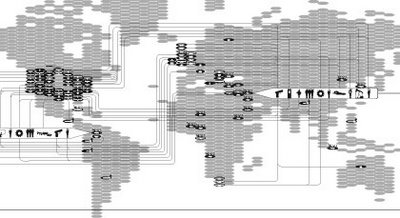
Commissioned for the Gwangju Biennial, this collaboration between artist Lize Mogel and writer Dario Azzellini diagrams the relationships between the United States and private military contractors (PMCs); and their activities in Columbia and Iraq. These nations are two key sites that exemplify PMC operation in the new world order.

The privatization of military services is a worldwide business worth $200 billion a year. PMCs are an enormous part of this economy, offering "products" from logistics (such as building and managing military camps and prisons) to strategic support (radar and surveillance) to open combat and special sabotage missions. PMC corporations are based globally, and recruit heavily in the global south.


Interview with Lize Mogel / by Trevor Paglen / artwurl interview #57

Lize Mogel is an artist working with geography and cartography. Her projects, often site-specific and distributed in public space, use the map as political agent. She is interviewed by artist and geographer Trevor Paglen.

Trevor Paglen: How did you come to work on your most recent project, which is about mapping the corporate structure of this new age of global war?

Lize Mogel: "The Privatization of War: Colombia as Laboratory and Iraq as Large-Scale Application" was originally commissioned by Cira Pascual-Marquina and Chris Gilbert for the Gwangju Biennial in South Korea. It diagrams the relationships between the United States and private military contractors (PMCs); and their activities in Colombia and Iraq. This was a sort of "blind date" collaboration - where Cira/Chris emailed me and asked if I wanted to do a mapping project with writer/researcher Dario Azzellini who had done a large amount of work on the "business of war" (while I had been involved in some research on American military interests while working with the Center for Land Use Interpretation). It was a somewhat globalized project - I’m in NYC, Cira and Chris live in Venezuela, Dario is in Berlin, and the show is in South Korea - and the project itself is about global flows, centered on Iraq and Colombia.... [continue]

artwurl.org is a non-profit webzine - project of PS122 Gallery, New York - that aims to provide a space for conversation, practice and research of contemporary critical, conceptual and political art.


MAPQUEST / Exhibiton on view from September 16 – October 9, 2006 at PS122 Gallery, New York

Mapquest brings together work by artists, activists, writers and organizers, involved in experimentation with critical and dissident cartography. The exhibition examines various mapping strategies employed as response to specific social and political issues. Working not unlike investigative journalists, some participants conduct and map in-depth research of themes such as the functioning of private military contractors or recruitment centers. Others design maps as tools, featuring information that can be used to support for social action. In a similar vein they employ mapping strategies to produce alternative knowledge about networks of power and control in urban spaces.

Works by: Lize Mogel and Dario Azzellini / Daniel Blochwitz / Cartographic Perspectives: Map Art / Center for Urban Pedagogy (CUP) / Ewen Chardronnet / The Friends of William Blake / Elise Gardella / Ryan Griffis - Temporary Travel Office / Ashley Hunt / Lasse Lau / Nadxieli Mannello / Carlos Motta / Sarah Ross / Gregory Sholette / curator Elena Sorokina.

Misc.

"Outsourcing the war" / P.W. Singer / Salon.com

"A government in search of cover: PMCs in Iraq" / David Isenberg / British American Security Information Council

Bibliography / Private Military and Security Companies
NYU / Institute for International Law and Justice


CorpWatch : Privatization

CorpWatch : War Profiteers

Monday, August 28, 2006

Pages & Bidoun


Pages began its activities in February 2004 by publishing a bilingual - Farsi/English - periodical pursuing an exchange between Iranian and international authors and artists with critical views on art, culture, urbanism and social issues.

Soon after publishing the second issue of the magazine, Pages began to develop collaborative projects with practitioners in different cultural fields. Its activities transcended the magazine format into other layouts, these may be installation works, video essays, workshops and presentations. As supplements to the magazine, the projects were often accompanied by publications such as a newspaper, posters, booklets, etc.

Pages is interested in those cultural productions that communicate the specific conditions and circumstances in which they are produced, those socio-political conditions against which an artistic production is inevitably read as a discourse. In particular through a series of projects Pages tries to examine the possibilities of interaction and juxtaposition of various local discourses and conditions. As such Pages constantly searches for ways to surpass predefined and geographically bound discourses of subjectivity and locality.

Being a bilingual magazine already forces Pages into constant rethinking of its position within specific social and political contexts. In effect this seems to reassert a certain unpredictability into the pages of the magazine. Pages tries to constantly point to those intricacies and dissonances within local currents that give way to alternative chains of meanings, relations and coincidences.

Current Issue: On the Verge of Vertigo / Issue 05 / August 2006


BIDOUN was created as a platform for ideas and an open forum for exchange, dialogue and opinions about arts and culture from the Middle East. BIDOUN's primary goal is to bring together cultural expressions from a vast and nuanced region. BIDOUN also addresses some of the widespread misconceptions about the region and its Diaspora by inciting readers to take a fresh look at the Middle East and its peoples, too often presented as one-dimensional or stagnant.

BIDOUN means 'without' in both Arabic and Farsi. In our contemporary context, it connotes the statelessness in which many of us find ourselves-sometimes voluntarily, sometimes not.

BIDOUN is not limited by political boundaries drawn onto maps. Its very essence is the fluidity of geographies and a challenge to the myth of singular and absolute representation. Yet we are cautious with our role as culture broker. While we acknowledge the reductionist tendencies of orientalism, BIDOUN also resists obsessing over cultural difference.

This is not about being authoritative. Rather, BIDOUN is an experiment: a collection of voices whose sum total aims to engage.

Current Issue: TOURISM / Issue 07 / Spring 2006

Friday, August 18, 2006

Practice, Power, Politics, and Performance

"The tradition of the oppressed teaches us that the "state of emergency" in which we live is not the exception but the rule. We must attain to a conception of history that is in keeping with that insight."

Walter Benjamin

"Theses on the Philosophy of History"
Walter Benjamin: Illuminations, ed. Hannah Arendt (1968)


Practice, Power, Politics, and Performance: A Symposium in honor of Allan Pred

UC Berkeley / Department of Geography
Friday, April 21, 2006

Organized and chaired by Gillian Hart

QuickTime Videos of the Presentations

Gillian Hart, UC Berkeley
Michael Watts, UC Berkeley
Richard Walker, UC Berkeley
Richard Peet, Clark University
Neil Smith, CUNY
Matthew Sparke, U of Washington
Shiloh Krupar, UC Berkeley
Derek Gregory, U of British Columbia
Katharyne Mitchell, U of Washington
Cindi Katz, CUNY
Trevor Paglen, UC Berkeley
Gunnar Olsson, Uppsala University
Allan Pred, UC Berkeley

Allan Pred / UC Berkeley / Department of Geography

Interests: Critical human geography, historical geography of the present, the cultural reworking of "globalization," Sweden, Europe and the U.S.

I am totally unconcerned with the disciplinary limits of geography, but fully concerned with geography as an ontological condition, as an inescapable existential reality. Everybody has a body, nobody can escape from their body, and consequently all human activity-- every form of individual and collective practice-- is a situated practice and thereby geographical. I regard the invisible geographies of power relations and meaning/discourse as every bit as "real" as the visible geographies of the built landscape and actual human activity. Whether exploring the historical geography of past and present urban modernities, or the production of gendered and "racial" difference, I am always preoccupied with the complex and multi-scaled processes through which visible and invisible geographies emerge out of one another.

Although my work of recent years may be characterized as "cultural," I insist there is no way in which the cultural may be entirely divorced either from the social and the political, or from the situated practices of everyday life and the workings of capitalism.

Among my principal influences are Walter Benjamin, Michel Foucault, Raymond Williams and the cultural Marxists who have followed in his wake, and feminist theory.

I take writing and questions of representation very seriously, believing that there should be some congruence between my textual strategy and the subject matter I am dealing with, between the way in which I write and what I am writing about. I look forward to the day when the watchdogs of academic style lose their teeth and it will not be considered out of line to submit Ph.D. dissertations in CD-Rom format, where text, sound and image are fused with one another.

My most recent seminars have gone under the following rubrics: Space, Place and Identity; Walter Benjamin, the City and Urban Modernity; Interrogating and Representing the Present Moment and its Modern Antecedents; Urban Modernities—Culture(s), Space(s), Everyday Life.

Books:

Violent Geographies (Forthcoming)

The Past Is Not Dead: Facts, Fictions, and Enduring Racial Stereotypes (2004)

Even in Sweden: Racisms, Racialized Spaces, and the Popular Geographical Imagination (2000)

Place, Practice and Structure: Social and Spatial Transformation in Southern Sweden, 1750-1850 (1986)

Misc:

UC Berkeley / Geography Commencement 2006
Keynote Address: "What do YOU know?: The Clock is Ticking, The Train is Rolling On"
Allan Pred / May 13, 2006