Wednesday, September 03, 2008

A Call To Farms / Midwest Radical Culture Corridor


A CALL TO FARMS: Continental Drift through the Midwest Radical Culture Corridor

Featuring the words of Claire Pentecost, Jessica Lawless and Sarah Ross, Lisa Bralts-Kelly, Brett Bloom and Bonnie Fortune, Ryan Griffis, Mike Wolf, Martha Boyd and Naomi Davis, Rebecca Zorach, Nicolas Lampert, The Langby Family, Eric Haas, Sarah Holm, Brian Holmes, Dan S. Wang, mIEKAL aND, and Sarah Kanouse

FREE Download (PDF)

Designed by The Heavy Duty Press, offset printed at Bookmobile
8.5 x 6.75", 60 pages plus cover, first printing: 500 copies, $10
Available soon at the Heavy Duty Etsy Store.

MRCC & Continental Drift Resources

MRCC Blog

MRCC Drift @ Flickr

"The Midwest Radical Cultural Corridor in the Recent Past and the Distant Futures" / Brian Holmes

"Finding, Being the Radical Midwest" / Dan S. Wang

The MRCC Schedule

Continental Drift & 16Beaver

"Songs of Returning, Both Silent and Aloud" (The Domestic Struggle Part Threee) @ Art of This
Minneapolis, Minnesota
August 23 - September 7, 2008

"The Audacity Of Desperation"
Urbana, Illinois
May 7 - June 15, 2008

Tuesday, July 29, 2008

The Missing Plaque Project


History can be a tool for social change. It is often said that the victors of history write the history books in their favor. Some stories are promoted, and others are left to dwindle in obscurity. The Missing Plaque Project tries to stand as a force to stop this from happening, by shedding light on the hidden histories.

The project is based in Toronto, and has dedicated itself to changing the way we think about Toronto's history. The city's history is often portrayed as being conservative, British and boring. However, that is only part of the truth. People have lived in the area for thousands of years, but most people think of it as a young city with very little history. It is not that nothing is known of life here before the British set up shop, in 1793; rather those stories are not given the attention they deserve.

Another element to how Toronto's history is portrayed is that anything bad that happened in the city took place long in the past and that since multiculturalism was "invented" in the 1970's everything has been "honky dory". To cast this image many stories have been ignored, including the Bathhouse Raids (1981), the Yonge Street Riot (1992), and the treatment of homeless people.

But why are some histories overlooked? Racism and other biases are partly to blame. Another part of it is the result of efforts to always portray Toronto in a good light, or efforts to use history as a tool to promote tourism or to increase property values. Another part is that many of the people who do work around the city's history come from a narrow background and happy to focus on the history of the British and the rich. Many of them are interested in what most people find banal. Often are happy to look at the history of buildings in the city rather than the people who lived here, and the social turmoil of the past.

Most Torontonians don't find the history of their city relevant to their lives. The Missing Plaque Project attempts to show how our history is relevant to us today. The project does all it can to get people interested and thinking about our cities history. Although the project has began to use a variety of mediums, it started as a project to put up posters about little-known histories.


The project started on a freezing cold December night in 2002. After spending the evening at Kinko's, the founder of the project, Tim Groves, set out for Christie Pits with a steaming bucket of wheat paste and a roll of posters on the Christie Pits Riot. The idea of putting up posters had come to him as soon as he had learned the story of this riot. Before long, ideas for other posters sprang to mind. Slowly new posters were made.

One of the ideas behind putting up the posters is that they can be up right on the street in the areas where people live. Instead of having to go out of your way to learn about the history it can be stumbled on by anyone in the neighbourhood that the history took place.

One dilemma of using posters is that people have to stand in order to read them. They can not take it with them to sit down somewhere comfortable. This would suggest that the posters need to be as short and as easy to read as possible. However, we have been resistant to this, because so many historic plaques mark only that an event happened, but not why it is relevant. The content of our posters is a constant struggle between these two extremes.

In 2006, it was decided to move the project in more ambitious directions. Not only is the number of posters being expanded, but plans are underway to incorporate a variety of other mediums, to seek funding, and to find collaborators to work on various projects.

The Missing Plaque Project Blog

List of posters that may be released in the future

Guided Tours

The poster's potential / Tim Groves


Via Just Seeds

Monday, June 23, 2008

David Harvey

Reading Marx’s Capital with David Harvey

David Harvey, Distinguished Professor of Anthropology at the Graduate Center of the City University of New York, has been teaching Karl Marx’s Capital, Volume I for nearly 40 years, and his lectures are now available online for the first time. This open course consists of 13 two-hour video lectures of Professor Harvey’s close chapter by chapter reading of Capital, Volume I.

Reading Marx’s Capital - Class 1, Introduction


Reading Marx’s Capital - Class 2, Chapters 1-2


The Right to the City (Part I)
Lecture by Professor David Harvey
Department of Geograhy / Lund University
May 28, 2008


The Right to the City (Part II)


Spaces of Global Capitalism: Towards a Theory of Uneven Geographical Development

Lecture by Professor David Harvey
Department of City & Regional Planning / Cornell University
March 13, 2008

(Part 1/10) / (Part 2/10) / (Part 3/10) / (Part 4/10) / (Part 5/10) / (Part 6/10) / (Part 7/10) / (Part 8/10) / (Part 9/10) / (Part 10/10)


Introduction to Continental Drift
16beaver / New York, Fall 2005

David Harvey on Neoliberalism (Quicktime)/ (Part 1/2) / (Part 2/2)


Tuesday, June 17, 2008

Spectres of Liberty


Photo: Chris Harvey

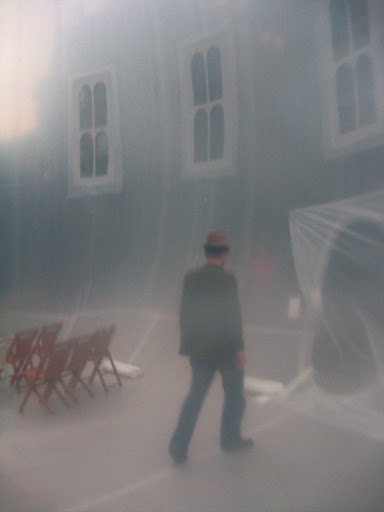
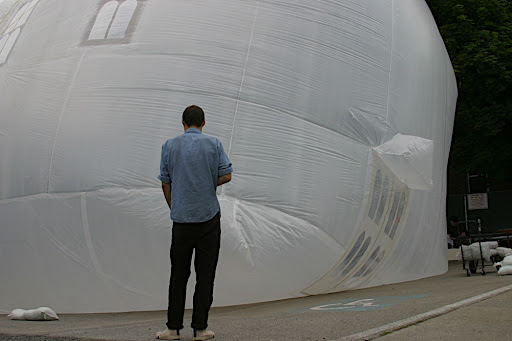
Spectres of Liberty is a public memory, site-specific art project. Beginning with a sense of loss about the changing built environment of Troy, New York, we set out imagining ghosts of demolished buildings and structures. Through imagining inflatable sculptural extensions to buildings whose facades have been destroyed to thinking about recreating vanished historic sites, we decided on creating a ghost of the Liberty Street Church.

The Liberty Street Church is not only significant as a vanished part of Troy's architectural history, but also for its value as a historic site in the fight to abolish slavery. From old photos of the site provided by the Rensselaer Historical Society, we created an inflatable 1:1 scale reproduction of the church and will install it at the former site of the church, which is now a parking lot. We will be animating this ghost church through video projections that call forth the history of the site, as well as through the social context of a cultural event that will bring community members to the site to think more deeply about the space and its history.


Through our research we learned more about Henry Highland Garnet, the pastor of Liberty Street Church from 1843-1848. He was known around the world for his militant orations and publications calling on people to actively participate in the fight to end slavery. When we read Henry Highland Garnet's words from the 1840's: "Let your motto be resistance! resistance! resistance! No oppressed people have ever secured their liberty without resistance," we do not think they are dead words from a forgotten time - but a call, an urging, to participate in transforming our world now.

Spectres of Liberty is a project by Olivia Robinson, Josh MacPhee, and Dara Greenwald.

History / Pamphlet / Photos


Photo: Olivia Robinson

Thursday, April 24, 2008

La geografia esborrada de la Barceloneta


La Geografía esborrada de la Barceloneta


MAP > PDF

AUDIO > MP3

Passeja’t pel barri amb els teus auriculars, i deixa’t portar per les històries, imbueixe’t…

L’audio tour, és una saborosa barreja de veus, peces d’antigues cançons… el mar, les gavines… I explicacions obtingudes a través de la història oral del barri, acompanyades de deliciosos ar-pegis flamencs especialment composats per a l’ocasió. Tots els sons s’han obtingut, cuidadosament a la Barceloneta

VIDEO > Ruta por la Barceloneta desaparecida

La geografia esborrada, és un tour a través dels espais desapareguts del barri de la Barceloneta. Aquells que han estat emblemàtics, que han creat xarxes de solidaritat veïnals. És 1 projecte melancòlic, és un estat de turbulència i rebel.lió transitori, però no és 1 projecte purament regressiu i estancat en el passat. Vol saber sobre les seves arrels, vol llegir-les i sentir-les, vol explorar per reinventar, no pretèn idealitzar, vol obrir camins, portes….vol recordar, reimaginar…. Llegeix la història en diagonal, de principi a final, de final a principi, d’enmig cap amunt o cap avall. Cada espai que descobreix, és 1 nova font de circulació d’idees, formes i estructures que van connectant-se amb el reste de nuclis descoberts.